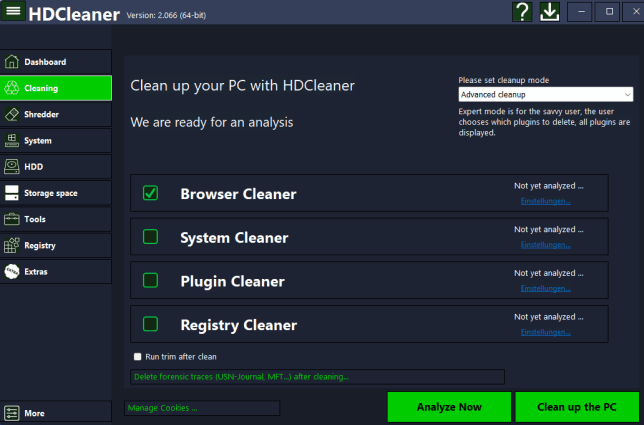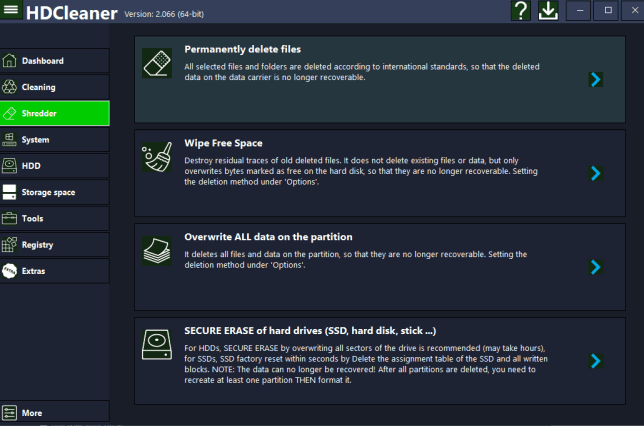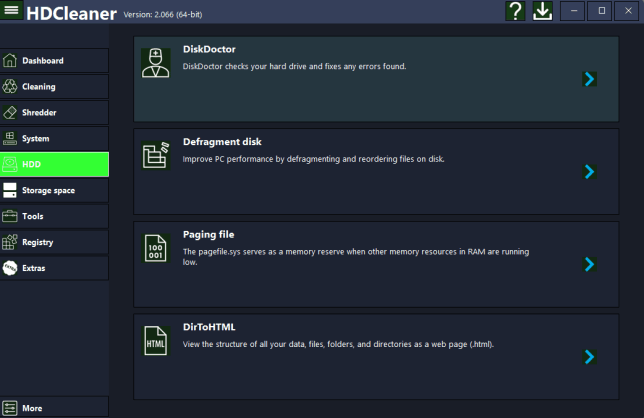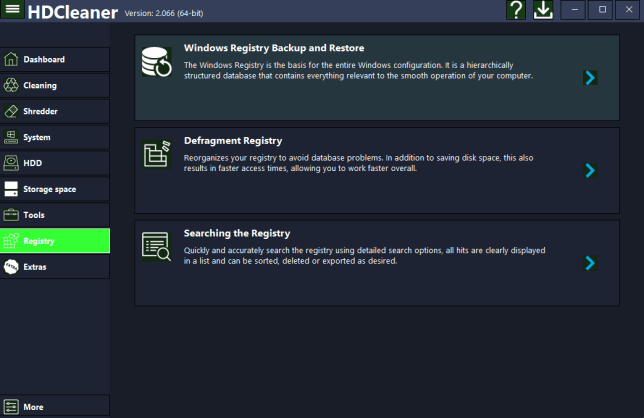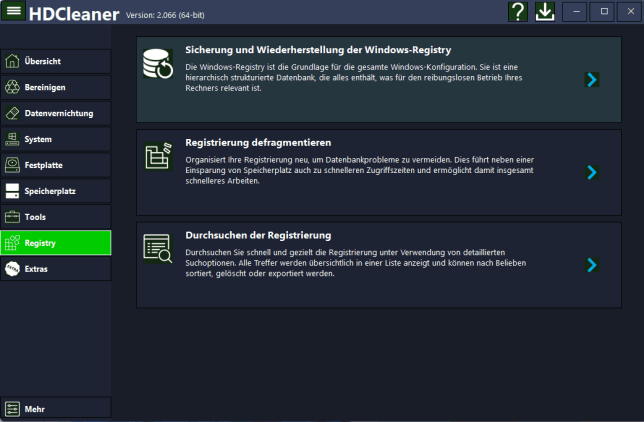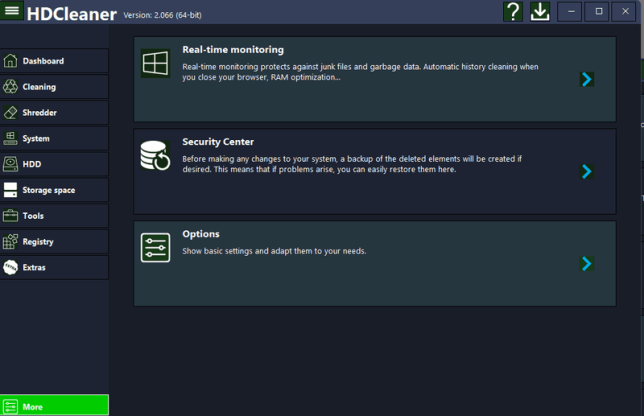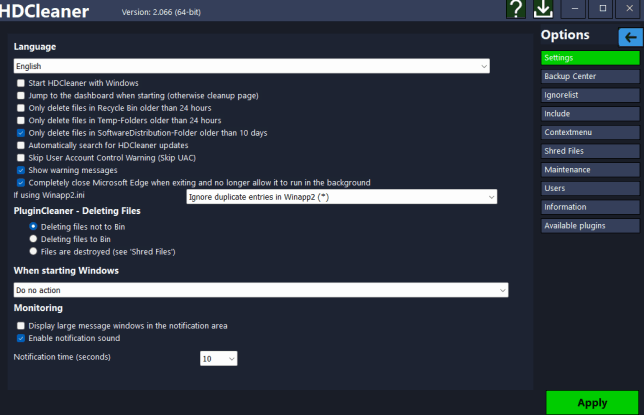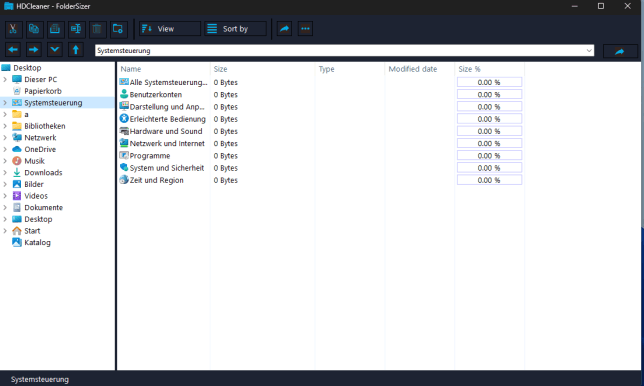
HDCleaner offers a comprehensive suite of programs for Windows system maintenance. Whether you want to declutter your hard drive, clean the registry, encrypt data, remove user traces, completely back up the registry, defragment it, or perform a quick scan – you'll always find the right tool in the clearly arranged "toolbox." With one-click optimization, the application organizes and cleans the registry, destroys internet traces, removes temporary files, defragments the registry, finds hard drive errors, and optimizes system startup. Optimized for use with solid-state drives (SSD) and hard disk drives (HDD).

With over 5,500 cleaning and repair functions, HDCleaner reduces junk files to a minimum, freeing up more system resources for Windows, using less memory, and running error-free, resulting in better PC performance.
HDCleaner lets you add any program on your system to have its data cleaned.
Supports Winapp2.ini.
Optimized for use with solid-state drives (SSD) and hard disk drives (HDD).

HDCleaner supports three cleaning modes:
Simple Cleanup - HDCleaner automatically scans for internet traces and junk files, which can be easily deleted. No user settings are required.
Standard Cleanup - This option is for standard users. The user determines which plugins should be deleted. Only the most commonly used plugins are displayed.
Advanced Cleanup - Expert mode is designed for experienced users. The user determines which plugins should be deleted. All plugins are displayed.
Prevent unnecessary programs from starting when your computer boots up. When you start your computer, more than just Windows loads. All of these automatically opening programs consume system memory and can slow down performance. Fortunately, managing startup programs isn't difficult with HDCleaner.
Uninstall programs you don't use; they only slow down your computer. This frees up disk space and saves resources. All associated files, settings, and registry entries will also be removed.
everycircuit manual
"The simulation is frozen / time is stuck."
Unlike a paper manual, EveryCircuit connects to the cloud.
The primary function of the EveryCircuit Manual is to demystify the interface, but its value lies in how it teaches the user to think digitally about analog systems. The manual begins by guiding the user through the mechanics of the "circuit editor." However, unlike traditional manuals that focus solely on menu navigation, this guide implicitly teaches circuit topology. By explaining how to drag, drop, and connect components, the manual forces the user to engage with circuit architecture—distinguishing between series and parallel connections, and understanding the necessity of a complete loop. It grounds the user in the "syntax" of electronics, ensuring that before a simulation runs, the structure is sound.
EveryCircuit does have hierarchical blocks, but you can:
Let's follow this to build a classic 555-style oscillator (using discrete transistors or just an RC circuit).
"The simulation is frozen / time is stuck."
Unlike a paper manual, EveryCircuit connects to the cloud.
The primary function of the EveryCircuit Manual is to demystify the interface, but its value lies in how it teaches the user to think digitally about analog systems. The manual begins by guiding the user through the mechanics of the "circuit editor." However, unlike traditional manuals that focus solely on menu navigation, this guide implicitly teaches circuit topology. By explaining how to drag, drop, and connect components, the manual forces the user to engage with circuit architecture—distinguishing between series and parallel connections, and understanding the necessity of a complete loop. It grounds the user in the "syntax" of electronics, ensuring that before a simulation runs, the structure is sound.
EveryCircuit does have hierarchical blocks, but you can:
Let's follow this to build a classic 555-style oscillator (using discrete transistors or just an RC circuit).